TECHNICAL SEOSEOGUIDE
Schema markup guide for beginners [Updated: July 2026]
Find out why Schema markup is important and how to implement it on your website
8 min read
There's been plenty of discussion about how AI is changing search. But what does it actually feel like to be an SEO specialist right now?
I've had a few conversations with good friends in the SEO industry recently that have stayed with me. We were talking about AI and how much our roles have changed, but not in the way we usually talk about AI in SEO.
We weren't debating AI Overviews, LLM visibility, GEO or AEO, or discussing the latest tools and what we should be measuring. The conversation was much more about us, how our jobs have changed and what it actually feels like to work in SEO while the industry is moving this quickly.
This made me reflect on my own experience.
There is a lot about this change that I find genuinely exciting. AI has made parts of my job easier and made me more productive in areas that would previously have taken considerably more time. I'm also fascinated by what's happening to search behaviour and how people find, explore, and evaluate information.
The search journey feels much less defined than it once did. Someone might move between Google, an AI platform, social media and a brand's website while researching the same thing. They can ask increasingly specific questions, continue a conversation rather than start another search, and discover information in ways that don't necessarily fit the search journeys we've spent years trying to understand.
As an SEO specialist, that's incredibly interesting. We're watching people's relationship with search change in real time, and there is still so much we don't know about where those behaviours will settle or what they will ultimately mean for organic search.
But I've also noticed something else. While AI can make individual parts of my job easier, the job itself doesn't necessarily feel smaller or easier.
If anything, my role feels like it has grown. There is more to understand, more to test, more to explain and a constant stream of new information to process. At times, I feel like I'm consuming more just to make sure I'm keeping up. At the same time, everything I was responsible for before is still there to manage.
SEO was already a broad discipline before generative AI became part of our everyday work. Depending on your role, you could be involved in technical SEO, content, analytics, UX, CRO, digital PR, development, reporting, strategy and stakeholder management, often moving between several of them in the same day.
Now we have another layer to think about.
We're trying to understand how people use AI platforms to search for information and how brands appear within those experiences. We're experimenting with new tools and methodologies, figuring out what we can reliably measure and how much of what we already know about search still applies.
At the same time, we're often being asked to explain all of this to clients, leadership teams or other stakeholders who understandably want to know what it means for them. The difficulty is that we're sometimes being asked for those answers while we're still working them out ourselves.
That's not necessarily unusual for SEO. We've always worked in a field where things change and where certainty can be difficult to come by. But the speed and scale of this particular change feels different to me.
And while the role is evolving, the things we've traditionally been responsible for haven't suddenly stopped mattering. Organic visibility still matters. Organic conversions still matter. Technical problems still need fixing. Content still needs planning. Migrations still happen. Reports still need writing, and stakeholders still have questions. Even more questions than before...
So I've found myself wondering: has the SEO role changed, or has it simply got bigger? More importantly, if the role has become bigger, have the expectations around it changed too?
This is probably the biggest change I've noticed in my own behaviour.
I've always consumed a lot of industry information. That's part of working in SEO industry. You need to know when something important changes, understand what other people are testing and challenge your own assumptions when new evidence comes along. But the volume of information around SEO and AI now feels completely different.
There are newsletters, LinkedIn posts, studies, experiments, podcasts, webinars, new tools and new terminology appearing constantly. Someone shares a finding, dozens of people interpret it, somebody challenges it and before long you're reading several different versions of what is essentially the same conversation.
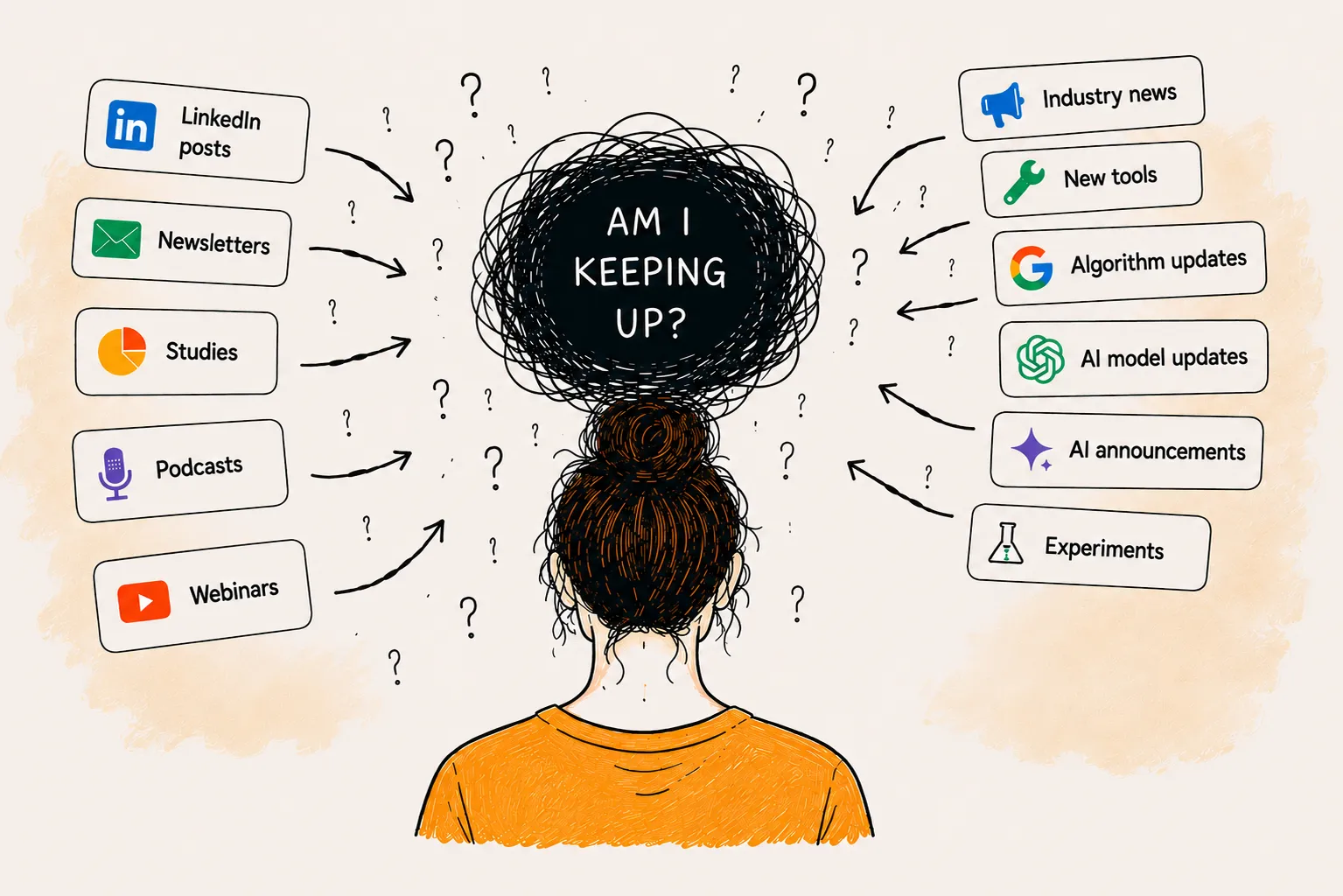
The problem isn't simply that there is a lot of information. It's the feeling that I need to consume and validate it.
What if something genuinely important happened today? What if a stakeholder asks about something I haven't seen? What if other people in the industry understand something that I don't?
That feeling can very quickly turn keeping informed into trying to keep up.
I've also started questioning how much of the information I'm consuming is actually helping me do my job better. There is a huge amount of genuinely valuable work being shared, but there is also repetition, speculation and information presented with much more certainty than perhaps it deserves.
Sometimes I'll see the same idea repeated across multiple places and start wondering whether it has become accepted because there is evidence behind it, or simply because enough people have repeated it. In an industry already known for uncertainty, that makes deciding who and what to trust increasingly difficult.
We have more SEO information at our fingertips than ever, but AI search is still a huge unknown and changing incredibly quickly. Sometimes, more information doesn't make me feel more informed. It just highlights how much we still don't know.
This is the part I've found harder to articulate, and probably the reason I started thinking about this topic in the first place.
Nobody has ever had all the answers, SEO industry often proves that. Google has certainly never made that possible, and testing, questioning and adapting have always been part of the job. But AI has introduced another level of uncertainty.
Things are changing quickly, established ideas are being questioned and we're trying to understand systems where we don't always have particularly good visibility into how or why something is happening.
At the same time, there is an enormous amount of commentary telling us what we should already know and what we should be doing about it.
I do wonder what that does to professional confidence over time.
You can have years of experience in SEO and still find yourself reading about a completely new area of the industry thinking, Should I already know this?
You can spend hours learning something only for the conversation to have moved somewhere else a few weeks later. You can also find yourself consuming industry information outside working hours simply because there never seems to be enough time to keep up with it during the day.
For me, that's where the conversation starts to become about more than simply learning new skills. It becomes a question of how this pace of change affects the way we work, how easily we switch off and even how confident we feel in expertise we've spent years building.
I think this part is important because I don't want to frame the conversation as AI is bad for SEO or AI is making me miserable (well, probably sometimes!). That's not how I feel about it, and I doubt the reality for the wider industry is that straightforward either.
AI has made me more productive. It can take away repetitive work, help me analyse things more quickly and create more space for the parts of SEO that require judgement, strategy and creativity.
But I've realised those benefits don't necessarily cancel out the other things I've been feeling. I can be more productive and still feel overloaded by information. I can be excited about where search is going while also feeling pressure to keep up with it. AI can make individual tasks easier while the overall scope of my role becomes larger.
Perhaps that's why reducing the conversation to whether AI is “good” or “bad” for SEO doesn't feel particularly useful. The experience can be both.
This is the question I keep coming back to.
If the role of an SEO has expanded, what has happened around it?
Have priorities changed? Have responsibilities been removed to make room for new ones? Are businesses giving people time to learn and experiment? Have teams been given additional resources? Have expectations about output changed because AI can supposedly help us work faster?
Or have we largely taken the job we already had, added AI to it and carried on?
I suspect the answer will be very different depending on whether somebody works in-house, at an agency or independently. It will probably vary by seniority, company and even by how much AI has actually become part of someone's day-to-day role.
And that's why I don't want to assume my experience represents everybody else's.
The more I've thought about this, the more I've realised that I'm less interested in another survey about which AI tools SEOs use or whether people are optimising for LLMs.
I'm interested in what it feels like to be an SEO specialist while all of this is happening.
Has your role changed since AI became a bigger part of the industry? Have new responsibilities been added without old ones disappearing? Are you expected to manage those changes with roughly the same time and resources as before?
Has the amount of industry information you consume changed? Do you feel pressure to constantly keep up? Is it becoming harder to know which sources you can trust?
And what has that done to the way you feel about your work?
Perhaps you're more productive and enjoying SEO more than you did before. Perhaps you're overwhelmed by it and looking forward to your weekends more than ever before. Perhaps you're experiencing a slightly contradictory mixture of both.
That's what I'd like to understand.
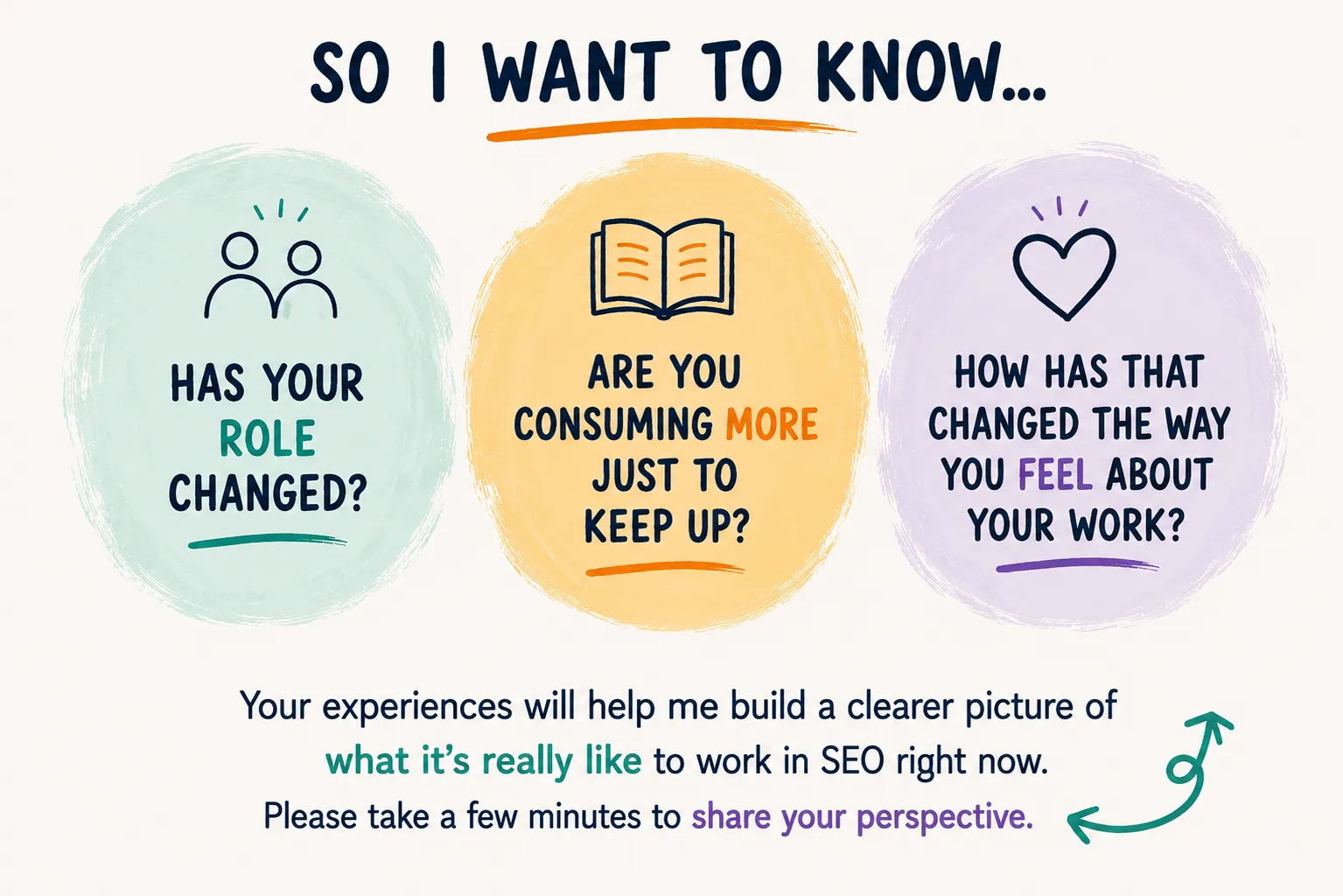
So I'm putting together a short survey for people working in SEO industry. I deliberately want to keep it short, just a few questions about how the role has changed, how we're responding to that change and whether it has affected our wellbeing at work.
We've spent a huge amount of time discussing what AI is doing to search.
I think it's worth asking what it's doing to the people trying to keep up with it too.
Find out why Schema markup is important and how to implement it on your website